
Agent Skills Beyond Coding: A Universal Standard for Agent Workflows
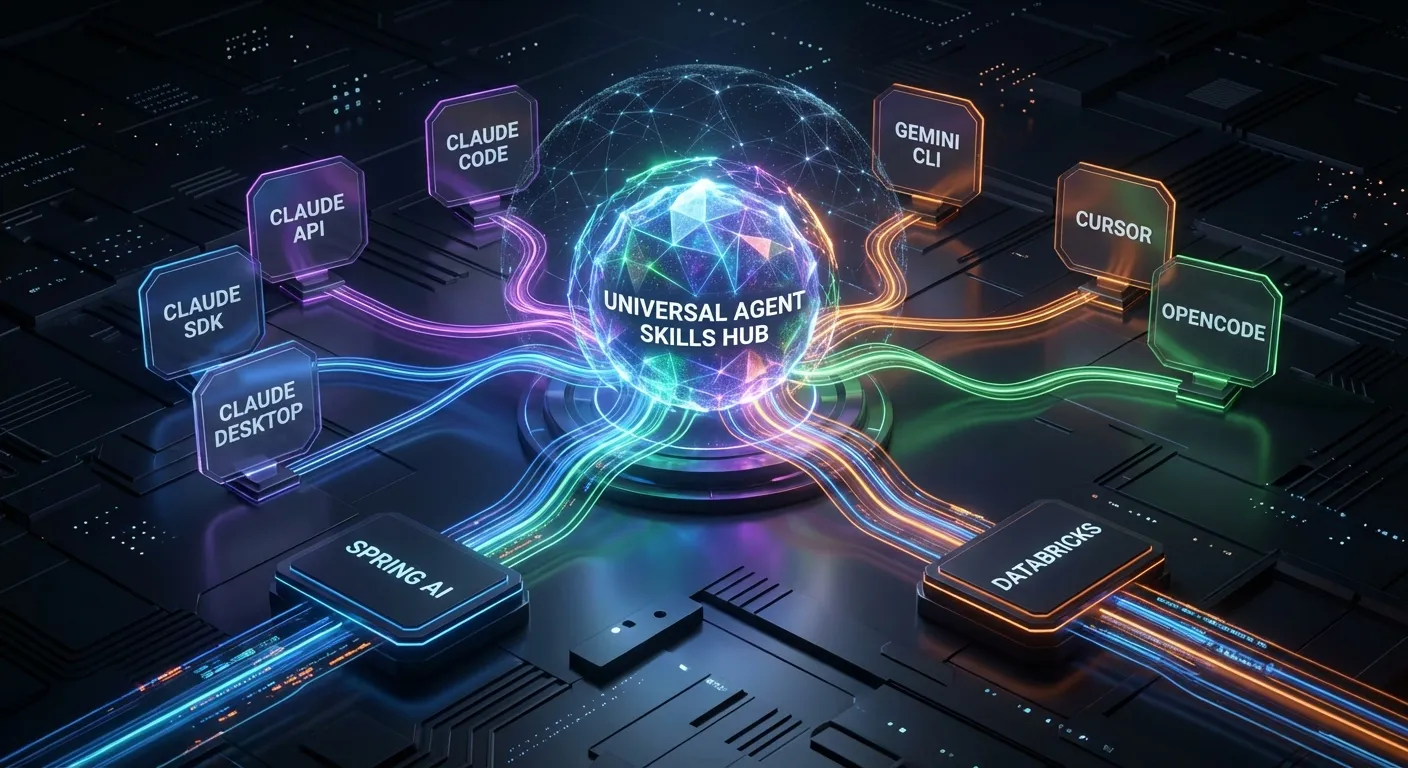
Agent Skills is already a general-purpose standard for agent workflows, not just a feature for coding copilots. Because both the Claude API and the Claude Agent SDK support Skills across coding, business, and data workflows, the format is quickly becoming a universal way to package capabilities for many types of agents.
Agent Skills, beyond coding
Agent Skills are lightweight folders (centered on a SKILL.md file) that bundle instructions, scripts, and resources so agents can discover and load them on demand. Skills are designed to encode domain expertise, reusable workflows, and organization-specific context—whether that is a code refactor recipe, a legal review checklist, or a data analysis pipeline. This makes Skills an abstraction for "how to do work" in any domain, not just software development. agentskills
Anthropic released Agent Skills as an open standard, with the spec hosted at agentskills.io and a reference implementation across Claude products. The same skills that run inside Claude Code for multi-file edits can also be used via the Claude Messages API and the Claude Agent SDK, letting teams reuse one skill library across coding agents, chat assistants, and custom back-end agents. Enterprise features like centralized skill management and a partner directory (Atlassian, Notion, Canva, Figma, Stripe, Zapier, etc.) show that Skills are already used in production for legal, finance, data science, and workflow automation, not just IDE automation. github
Claude API and Claude Agent SDK
Claude exposes Skills in two main ways: through the hosted API and through the Claude Agent SDK. With the Claude Messages API, developers attach Skills into a container configuration, enabling both pre-built and custom Skills to be invoked automatically during tool-using conversations. Skills here are used to extend Claude with domain-specific capabilities—such as generating dashboards, running ETL scripts, or enforcing review checklists—alongside typical coding tasks. platform.claude
The Claude Agent SDK loads Skills from the filesystem (for example, .claude/skills/ directories) and treats them as first-class tools agents can call when relevant. SDK options like setting_sources and allowed_tools determine which skills are available and how they interact with other tools such as file I/O or shell execution, allowing complex, multi-step workflows that combine skills with traditional tools. This makes Skills a shared capability layer across Claude Code, the Claude web app, custom back-end agents, and enterprise automation that all draw from the same skill packages. platform.claude
Coding-focused tools and their specialties
A large set of tools use Skills to power coding agents and development workflows, but they address distinct niches within the developer ecosystem. cursor
VS Code & GitHub / Copilot: VS Code acts as the primary IDE host where Agent Skills-compatible agents like GitHub Copilot can load skills directly from projects. This addresses the mainstream developer market, letting skills encode repo-specific build commands, test workflows, and refactor recipes that Copilot or other agents can reuse across teams. nocentdocent.wordpress
Claude Code: Claude's own coding environment uses Skills as modular capabilities for repo-scale edits, templated refactors, documentation generation, or project bootstrapping. Its specialty is multi-file, safety-focused coding workflows where skills can implement complex patterns like framework migrations or invariant-preserving refactors. platform.claude
Cursor: Cursor integrates Agent Skills as part of its AI-native editor context system, letting skills define reusable tasks such as "add logging to all handlers" or "standardize HTTP clients." It targets power users who want an IDE that can repeatedly execute structured workflows over entire codebases using shared skills. avanderlee
Goose: Block's goose framework is one of the founding projects in the Agentic AI Foundation and supports Agent Skills as a way to plug domain workflows into its agent framework. Goose targets developers building open, scriptable coding agents and infrastructure automation, using skills to define repeatable tasks that agents perform over code or systems. nocentdocent.wordpress
Amp: Amp is part of the early Agent Skills ecosystem and focuses on agentic developer workflows like bulk refactors, codebase maintenance, and repetitive task automation. Skills here encapsulate multi-step dev flows—run analysis, propose edits, apply patches, and verify with tests—so teams can standardize how agents touch their repos. nocentdocent.wordpress
Codex (OpenAI Codex): Codex provides the model "engine" for many coding agents and now participates in the Skills ecosystem, meaning Codex-driven agents can interpret Skill folders to execute structured workflows. This primarily serves tool builders who want to pair Codex's code generation with portable, vendor-neutral skills that encode project-specific procedures. avanderlee
OpenCode / opencode: OpenCode represents open-focused coding agent tooling that uses Agent Skills to define behavior, targeting teams who want transparent, extensible agents instead of proprietary black boxes. Skills let OpenCode-based agents reuse the same workflows across environments and model providers, enhancing portability. agentskills
Gemini CLI (Google): Gemini CLI supports both AGENTS.md and Agent Skills, positioning it as a bridge between Google's models and the open skills ecosystem. It targets developers who live in the terminal and want to run multi-file edits, tests, and scripted workflows using skills as reusable "commands" that work across different projects and even different model backends. vercel
Factory: Factory is an AI development workflow tool that uses Agent Skills to define reusable recipes for refactors, migrations, and project scaffolding. It focuses on orchestrating multi-step coding tasks at scale, making Skills the format for describing how to safely perform these operations across multiple services or repositories. agentskills
Agentman, TRAE, TORY: These are more agent-centric development tools that support Agent Skills, designed for orchestrated, higher-level "do this feature" workflows rather than just inline completion. They target teams building custom agents that can plan tasks, call tools, and use skills as reusable building blocks for implementation steps. agentskills
Data, infra, and domain agents
Agent Skills also power non-coding agents—particularly in data, infrastructure, and vertical SaaS workflows—showing that the format is more general than "dev tooling." spring
Databricks: Databricks uses Agent Skills to define workflows for notebooks, lakehouse ETL, data quality checks, or ML operations, giving agents procedural knowledge about how to run clusters, pipelines, and experiments safely. This targets data engineers and data scientists who want repeatable, auditable workflows that can be invoked by agents inside notebooks or jobs. nocentdocent.wordpress
Mux: As a video infrastructure provider, Mux leverages skills to encode tasks like setting up streams, analyzing QoS metrics, or generating observability dashboards. Agent Skills let agents in Mux-centric environments automate video workflows without hard-coding platform details into prompts. agentskills
Spring AI: Spring AI uses Agent Skills to bring modular capabilities into Java/Spring applications, using skills to define documentation generators, domain-specific assistants, or back-office automation workflows. This serves backend developers who want agentic features in microservices and enterprise apps while remaining portable across LLM providers and deployment environments. spring
Letta: Letta is an open-source agent framework that supports Agent Skills as pluggable behaviors for long-running or multi-step agents. It targets teams building custom agents—support bots, research copilots, internal tools—that need to reuse the same domain skills across many applications and environments. github
Why this is becoming universal
In practice, Skills now sit at the intersection of multiple standards efforts: MCP for connecting agents to tools, AGENTS.md for repository-level agent instructions, and Agent Skills for packaging reusable workflows. The Agentic AI Foundation under the Linux Foundation helps coordinate these efforts, with founding contributions from Anthropic, Block, and OpenAI and anchor projects including MCP, goose, and AGENTS.md. Skills, in that ecosystem, play the role of a portable "capabilities layer" that any compatible agent—coding or not—can load. agentskills
Because the same Skill can be consumed by Claude Code, the Claude API, the Claude Agent SDK, VS Code agents, Cursor, Goose, Gemini CLI, Spring AI, and more, developers and organizations can author a workflow once and reuse it broadly. That is why Agent Skills is increasingly not just for coding agents: it is becoming a universal, file-based interface for embedding procedural knowledge and domain expertise into any agent, across tools, vendors, and use cases. platform.claude
Discover AI Agent Skills
Browse our marketplace of 41,000+ Claude Code skills, agents, and tools. Find the perfect skill for your workflow or submit your own.